Five Ways I Tried Offering Bella More Water
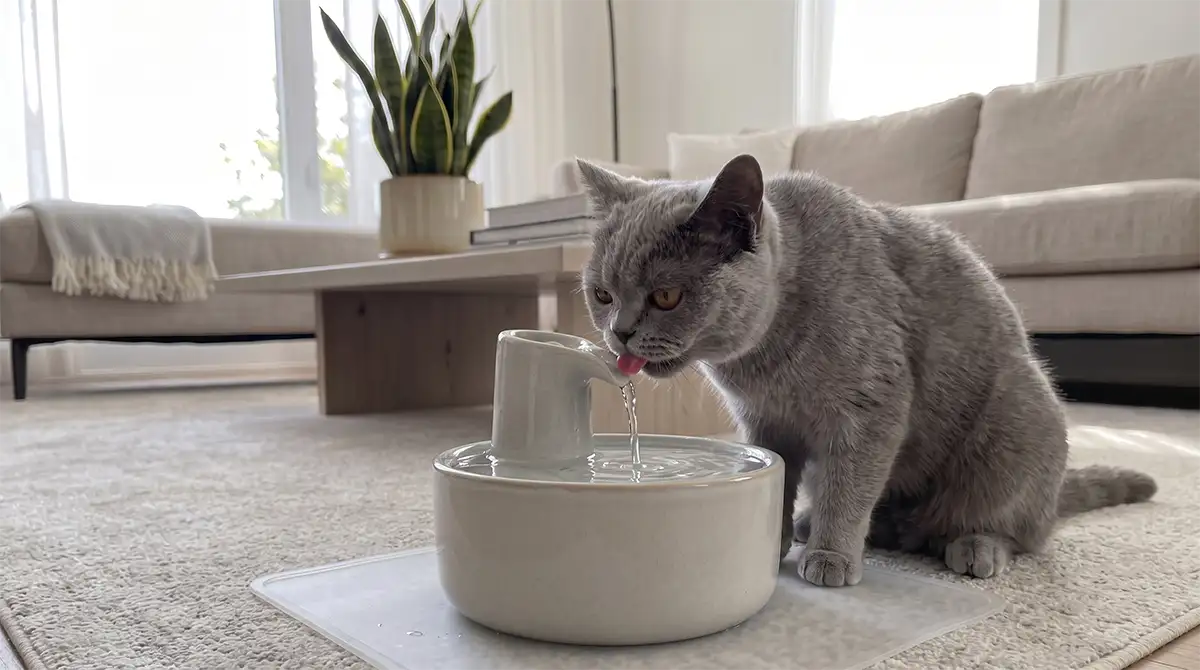
When I first brought Bella home, I worried about how little I saw her drink. Cats get water from food as well as their bowl; British Shorthairs are not known to have a unique, “programmed” thirst defect.
Back then, her water bowl was practically just for show. Even though I refilled it every day, the water level barely budged.
Until one night.
She curled up inside her cardboard box. Letting out soft, pained whimpers. She didn’t come out for half an hour.
I gently rubbed her belly and felt something was off. Every time I touched it, she would flinch and let out a pained meow.
I immediately panicked and rushed her to the vet.
I cannot confirm the diagnosis from her clinical record or establish whether this was the episode described in my other articles. It would be wrong to call it a confirmed urethral obstruction.
Urinary signs have several possible causes; low water intake alone does not establish the cause. iCatCare’s urinary guidelines distinguish these conditions.
Urgent: repeated straining with little or no urine needs immediate veterinary attention. Do not wait for a new bowl or diet to help, and do not press the abdomen to try to empty the bladder. See Cornell’s urinary guidance.
Afterwards I tried changing how I offered water. Three approaches got a more positive response from Bella; I did not measure her total daily intake or test whether any method prevented illness.
Methods I Tried but Failed
1. Changing the drinking environment
I moved the water bowl from the living room to the kitchen.
Every time Bella passed by, she would just sniff it. Lick it once. And walk away.
I then moved it from the kitchen to the bedroom. I thought maybe she did not like the smell of cooking grease in the kitchen.
Still nothing. She walked away without drinking. It was so frustrating. 😣
2. Changing the water and washing the bowl frequently
I chatted with friends and coworkers. Were there any other solutions?
Could she be unhappy with the water quality?
So I changed the water to fresh, cooled boiled water twice a day — morning and night. I even tried mineral water.
I washed her water bowl cleaner than my own.
But Bella’s attitude toward drinking remained the same. She would not drink it. 😫😫😫 Fresh water and clean bowls still matter, even when they do not visibly change drinking habits.
3 Methods Bella Accepted
Method 1: Switch to a wide-mouthed ceramic bowl
This was the vet’s advice.
A wide, shallow bowl was worth trying for Bella’s preferences. But “whisker fatigue” is not an established explanation for her drinking habits. A study of food bowls found no improvement in eating measures with a whisker-friendly dish; it did not test drinking or diagnose Bella.
After hearing the vet’s advice, I quickly replaced the original narrow-mouthed, deep water bowl with a wide-mouthed, shallow ceramic bowl. The rim diameter was a full circle larger than Bella’s face.
That very evening, she stood at the edge of the bowl and drank for quite a while. I was almost moved to tears with joy. 😄😄😄😄😄
Method 2: Water fountain (requires patient guidance)
Some cats prefer moving water; others prefer still water. A fountain still needs cleaning and filter care. International Cat Care’s drinking guide suggests a gradual introduction.
But Bella is a bit timid.
On the first day I brought the water fountain home, the hum of the pump scared her so much that she immediately darted under the couch. She would not come out.
But I did not give up on this approach.
Step 1: I unplugged the fountain and turned it into a regular water bowl. I left it out for several days.
Step 2: Once Bella had gradually accepted this new object and started drinking from it normally, I plugged it back in.
Step 3 — a mistake I would not recommend: I covered half of the spout with medical tape to reduce the sound. Do not copy that modification. For noise, try a quieter model or a vibration-damping mat, following the manufacturer’s instructions.
She watched it from a distance for two days. Finally, one evening, she quietly crept over and tentatively licked a few sips.
She took a few sips that evening. I also remember times when she ignored a fountain; I cannot place the devices or periods in order. This moment does not mean she always preferred running water.
Method 3: Wet food + water
This was a useful way to add moisture to her meals. Wet foods commonly contain about 70–80% water, but the amount depends on the portion and label—not the size of an unspecified bowl. It is not treatment for dehydration. See Cornell’s hydration guide.
I open half a can of her main wet food for her every morning and evening. Occasionally, I also add a little warm water to her dry food.
I started with 10 millilitres and gradually increased the amount. That was my trial, not a target for every cat; diet changes should be gradual and suit the cat’s veterinary plan.
I noticed bigger urine clumps. That alone cannot confirm adequate hydration or rule out urinary disease. Contact the vet if drinking or urination changes.
A Bonus: The Cup She Chose
I also noticed Bella showing interest in my drinking glass. It was another preference I could see, not a way to measure how much she drank.
She would jump up on the table and put her head near the rim when I sat down with it.
Eventually, I just set aside a wide-mouthed ceramic cup just for her on the coffee table. I change the water every day.
Now that cup is completely hers.
When friends come over, they laugh and say, “Your cat has more of a ritual about drinking water than you do.”